Do You Need Scaffolding for Roof Repairs In Harrogate?

It is one of the most common questions homeowners ask when a roofing problem comes up: do I actually need scaffolding for this, or can the roofer just use a ladder?
The honest answer is: it depends on the work — but for most roof repairs on a standard two-storey property in Harrogate, scaffolding is either legally required, strongly advisable, or simply the only practical way to do the job properly and safely.
This guide explains exactly when scaffolding is and is not needed for roof repairs, what the alternatives are, and what you should expect to pay in the Harrogate area in 2026. At Sky High Scaffolding, we work alongside roofers and homeowners across North Yorkshire every week — so this advice is grounded in real local experience, not theory.
Short answer: For most roof repairs on a two-storey Harrogate property — including ridge work, chimney repairs, felt replacement, and anything more than a couple of tiles — scaffolding is either required by law or strongly recommended for safety and quality of work.
What Does UK Law Actually Say About Roof Work and Scaffolding?
The starting point for any discussion about scaffolding and roof work is the Work at Height Regulations 2005. These regulations apply to all work carried out at height in the UK — including on domestic properties — and place a clear legal duty on contractors to ensure that work at height is properly planned, supervised, and carried out using appropriate equipment.
Under these regulations, working from a ladder is only permitted where it is not reasonably practicable to use safer equipment, and where the work is of short duration and low risk. For most substantive roof work — anything beyond the most minor, brief task — these conditions are not met, and a proper working platform is required.
In practice, this means that any reputable, properly insured roofing contractor will insist on scaffolding for any significant roof work on a two-storey property. A roofer who offers to do the job from a ladder alone is either not aware of their legal obligations or is willing to ignore them — neither of which should inspire confidence.
As a homeowner, it is also worth understanding that your own responsibilities are not zero. If you knowingly allow a contractor to carry out unsafe work at height on your property, this can have implications for your home insurance and, in serious cases, your own liability. Insisting on proper scaffolding is not just sensible — it is the right thing to do.
Roof Repair Types: Do You Need Scaffolding? Quick Reference
Here is a straightforward guide to the most common types of roof repair work and whether scaffolding is typically required:
|
Type of Roof Work |
Scaffolding Required? |
|
Full roof replacement |
Yes — always |
|
Large section re-roofing (multiple tiles) |
Yes — strongly recommended |
|
Ridge tile repointing or replacement |
Yes — always |
|
Chimney repointing or rebuilding |
Yes — always |
|
Felt and batten replacement |
Yes — always |
|
Minor tile replacement (1–3 tiles) |
Debated — see below |
|
Lead flashing repair |
Usually yes |
|
Flat roof replacement |
Often yes — depends on access |
|
Gutter clearance or repair |
Sometimes — depends on height |
The grey area in the table above — minor tile replacement — is worth looking at in more detail, because it is the scenario homeowners most commonly ask about.
The 'Just a Few Tiles' Question: Ladder vs Scaffolding
It is a scenario many Harrogate homeowners have faced: a couple of roof tiles have slipped or cracked after a storm, the roofer says it is a 30-minute job, and suddenly there is a discussion about whether scaffolding is really necessary for such a small repair.
This is a genuinely nuanced question, and the honest answer involves weighing up several factors:
The case for scaffolding even on minor repairs
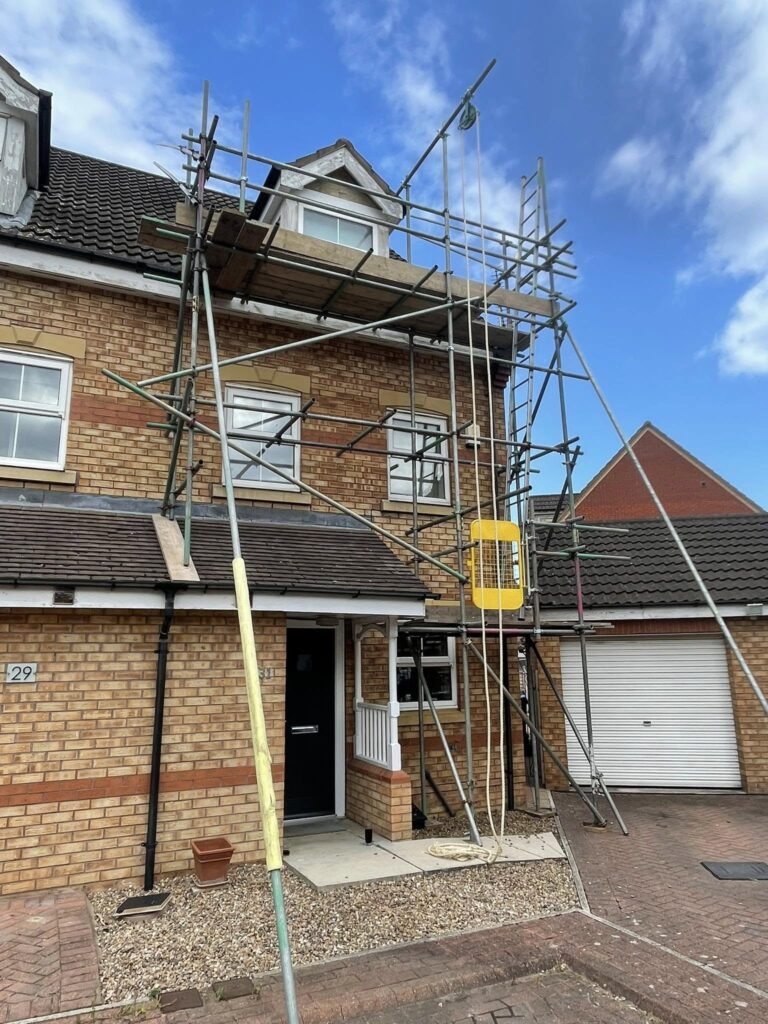
Even replacing one or two tiles on a two-storey roof involves working at height on a sloped, potentially slippery surface. The risks are real — falls from roofs are among the most common causes of serious injury and death in the construction industry, and domestic properties are no exception. The Work at Height Regulations exist precisely because ‘it will only take a few minutes’ does not make the hazard disappear.
A properly erected scaffold also allows the roofer to actually inspect the surrounding area while they are up there — which frequently reveals additional problems that would otherwise go unnoticed until they become a larger and more expensive issue. Rushing a minor repair from a ladder without proper access often means missing the wider picture.
When a MEWP or roof ladder may be acceptable
For genuinely minor repairs — replacing one or two individual tiles on an accessible, low-pitched roof — some contractors use a mobile elevating work platform (MEWP, sometimes called a cherry picker) as an alternative to full scaffolding. A MEWP can provide a safe, stable working platform for brief access tasks and is significantly quicker and cheaper to deploy than a full scaffold.
A roof ladder (a ladder with a ridge hook that anchors to the roof apex) is sometimes used for very minor tile work in combination with a properly footed access ladder. This is technically permissible under the regulations for brief, low-risk tasks — but it requires specific training and equipment, and is not appropriate for anything other than the most straightforward, rapid repair.
Sky High Scaffolding can advise on the most appropriate access solution for your specific repair. For anything beyond a genuinely minor tile fix on a low property, full scaffolding remains the safest, most practical, and most legally defensible option.
Be cautious of any roofer who enthusiastically tells you that scaffolding is unnecessary to save you money. The saving comes at a cost — to their safety and potentially to the quality of the work.
Why Harrogate Properties Often Need More Scaffolding Than Average
Harrogate’s housing stock presents some specific characteristics that make scaffolding more commonly necessary — and often more complex — than on a typical Yorkshire property.
Victorian and Edwardian height and pitch
A large proportion of Harrogate’s residential properties were built during the Victorian and Edwardian periods, when architectural fashion favoured tall, steeply pitched roofs with prominent ridge lines, decorative gable features, and multiple chimney stacks. These properties are significantly taller than a standard modern two-storey house, and the steep roof pitch makes working from any kind of temporary access far more hazardous.
For a Victorian terrace in the Duchy Road or Stray areas of Harrogate, a full three-lift scaffold is often required just to reach the eaves line safely — before any roof access is even considered. Add in chimney work on a tall stack, and the scaffold specification becomes more complex and costly still.
Chimney stacks
Harrogate’s older properties are well known for their impressive chimney stacks — often tall, ornate, and in varying states of repair. Chimney repointing, cap replacement, and stack rebuilding are among the most common roofing-adjacent jobs Sky High Scaffolding is called in for, and all of them require proper chimney scaffolding regardless of the size of the repair.
A chimney scaffold must surround the stack at working height, provide a stable platform for the operative, and be designed so that it does not load the chimney structure itself. For tall or structurally compromised stacks, this requires careful design — and is absolutely not a job for a ladder, regardless of how minor the repair might seem from the ground.
Weather exposure
Harrogate’s position in North Yorkshire means it experiences more weather exposure than many southern UK locations — higher rainfall, stronger winds, and more significant freeze-thaw action through winter. These conditions accelerate roof wear and increase the frequency of repair work needed. They also make working conditions at height more demanding, which reinforces the case for proper, stable scaffolding rather than temporary ladder access on any significant job.
How Much Does Scaffolding for Roof Repairs Cost in Harrogate?
The cost of scaffolding for roof repairs in Harrogate in 2026 varies depending on the size of the property, the extent of roof access required, and the duration of the works. Here are realistic guide figures:
-
Minor chimney scaffold (standalone, erect and dismantle): £300 – £600
-
Single-elevation scaffold for a rear or side roof section: £600 – £1,200
-
Full wrap scaffold for complete roof access on a semi-detached: £1,000 – £1,800
-
Full wrap scaffold for a large detached property: £1,800 – £3,500
-
Three-lift scaffold for a tall Victorian property: £1,500 – £3,000+
These figures include erection, a standard hire period of one to two weeks, and dismantling. Weekly hire charges apply if the work extends beyond the included period — typically £220 to £550 per week depending on the scaffold configuration.
One point worth emphasising: scaffolding for roof repairs is not typically included in a roofer’s headline quote. Most roofing contractors quote for their own labour and materials separately, and either arrange scaffolding as an additional item or leave the homeowner to organise it independently. Always confirm this when getting roofing quotes so you can compare on a like-for-like basis.
Tip: If your roof repair is alongside other exterior work — guttering, fascia, or rendering — combining everything under a single scaffold hire will save you money compared to booking separate scaffolds for each job.
Alternatives to Scaffolding for Roof Access
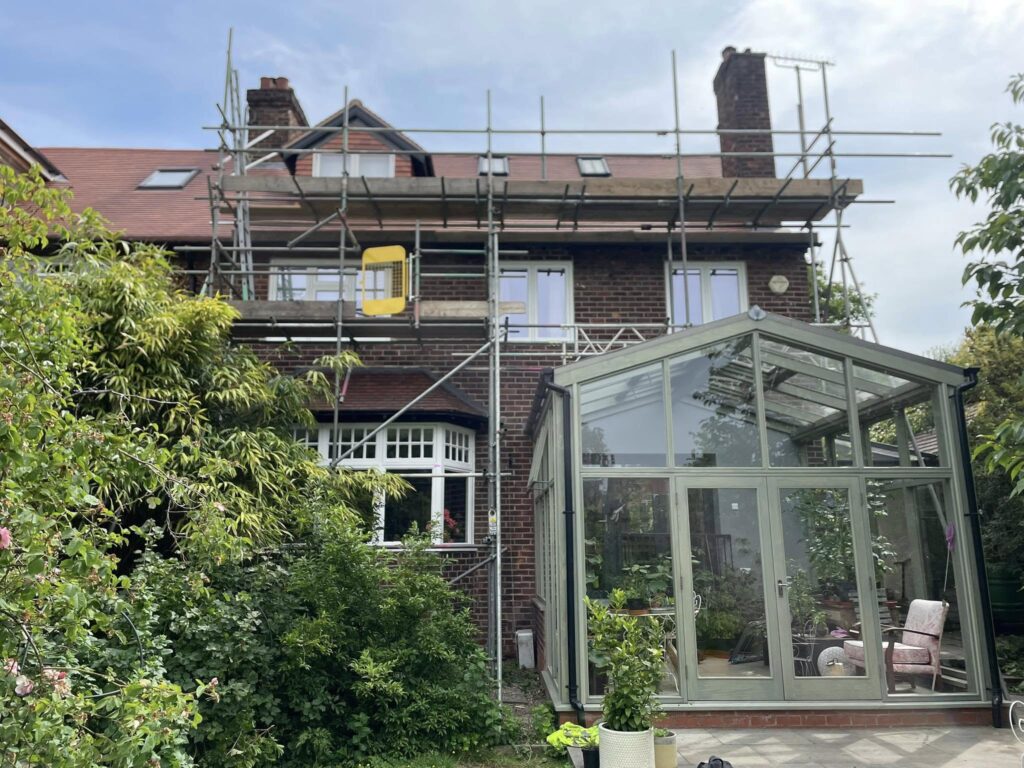
For completeness, it is worth covering the main alternatives to traditional tube-and-fitting scaffolding for roof access — along with an honest assessment of when each is and is not appropriate.
Mobile Elevating Work Platforms (MEWPs / Cherry Pickers)
A MEWP provides an elevated, enclosed working basket that can be raised to roof level. For brief access tasks on relatively accessible properties, a MEWP can be a cost-effective and fast alternative to erecting full scaffolding. However, MEWPs require level ground with sufficient space to position and stabilise the machine, which is not always possible on Harrogate’s older residential streets with narrow access and uneven ground. They are also not suitable for extended work periods, as the operative is confined to the basket rather than having free movement across the roof or scaffold deck.
Roof Ladders
A roof ladder — sometimes called a cat ladder — is a purpose-built ladder with a ridge hook that anchors over the roof apex, allowing an operative to move up a pitched roof surface. Roof ladders are a legitimate access tool for very minor, brief repairs carried out by experienced roofers with appropriate training. They are not, however, a substitute for scaffolding on any job of meaningful duration or scope — and they provide no fall protection for operatives working at the roof edge or at ridge level.
Scaffold Towers
Mobile aluminium scaffold towers can be appropriate for access to lower roof sections — single-storey extensions, flat roofs, or low-pitched porch roofs. For a standard two-storey property, a scaffold tower is not tall or stable enough to safely reach the eaves, and should not be used as a substitute for proper scaffolding on a pitched roof.
The bottom line: for any meaningful roof repair on a two-storey Harrogate property, traditional scaffolding — or in limited cases a MEWP — is the appropriate access solution. Anything else involves compromise on safety that most reputable roofers and scaffolding contractors will not accept.
Choosing a Scaffolding Contractor for Roof Work in Harrogate
If you are arranging scaffolding independently for a roof repair — rather than having your roofer organise it — here is what to look for in a local scaffolding contractor:
-
Experience with residential roof scaffolding in Harrogate — familiarity with the local housing stock, particularly Victorian and Edwardian properties, matters. A contractor who understands the specific demands of these properties will design a better, safer scaffold.
-
A site visit before quoting — roof scaffolding cannot be accurately specified or priced without seeing the property. Any contractor quoting from a description alone is guessing.
-
NASC membership or equivalent accreditation — the National Access and Scaffolding Confederation operates a register of accredited contractors who meet defined standards for safety, training, and insurance.
-
Comprehensive public liability insurance — a minimum of £5 million cover is standard. Ask for the certificate before work begins.
-
Clear written quotation — specifying the scaffold configuration, the hire period, the weekly rate beyond that, and what is and is not included in the price.
-
Willingness to liaise directly with your roofer — a good scaffolding contractor will communicate directly with the roofing contractor to ensure the scaffold is designed for the specific access requirements of the job.
Frequently Asked Questions
Can a roofer work without scaffolding in Harrogate?
For the most minor, brief repairs on accessible, low properties, a roofer may legally carry out work using a roof ladder and proper access ladder rather than full scaffolding. However, for any substantive repair — ridge work, chimney work, felt replacement, or anything requiring extended time on the roof — scaffolding is both legally required and practically necessary for safe, quality work. Any roofer suggesting they can safely complete significant work from a ladder alone should be treated with caution.
Does my roofer arrange the scaffolding or do I?
This varies between roofing contractors. Some include scaffolding within their overall quote and manage the process on your behalf. Others quote for roofing labour and materials only, leaving you to arrange and pay for scaffolding separately. Always clarify this upfront when getting roofing quotes, and make sure you are comparing quotes on a like-for-like basis — a quote that excludes scaffolding can appear much cheaper but ends up costing more once scaffolding is added.
How long will scaffolding be up for a roof repair in Harrogate?
For a minor to moderate roof repair — replacing a section of tiles, repointing a ridge, or repairing lead flashing — the scaffolding may only need to be in place for a few days to a week. For a full roof replacement or chimney rebuild, two to three weeks is more typical. Sky High Scaffolding provides scaffolding on a flexible hire basis so you only pay for the time you actually need, with weekly hire rates applying if the project runs longer than the standard hire period.
Is scaffolding for roof repairs tax deductible?
For homeowners, scaffolding on a private residence is not generally tax deductible. However, if the property is a rental property, the cost of scaffolding for maintenance and repair work may be claimable as a revenue expense against rental income. This is a complex area and depends on the nature of the work and the specific tax position of the landlord — speak to a qualified accountant for advice specific to your circumstances.
Will scaffolding damage my roof or guttering?
A properly erected scaffold should not cause any damage to your roof, guttering, or any other part of the property. Sky High Scaffolding uses appropriate fittings and protection where the scaffold makes contact with the building, and we carry out a pre- and post-installation inspection to confirm the condition of the property. If you have any concerns about a specific feature of your property — fragile tiles, period guttering, or conservation area requirements — raise these at the site survey stage and we will design the scaffold accordingly.
Planning a Roof Repair in Harrogate? Sky High Scaffolding Can Help
Whether you are dealing with a leaking roof after a winter storm, crumbling chimney pointing, or a full roof replacement that has been on the to-do list for too long, Sky High Scaffolding is here to provide safe, reliable access for your roofing contractor — or to advise you on the best access solution for your specific situation.
We are a local Harrogate scaffolding company with extensive experience of the area’s housing stock — from Victorian terraces in the town centre to large detached properties in the surrounding villages. We carry out a free site survey before every job, provide a fully itemised written quotation, and liaise directly with your roofer to ensure the scaffold is designed for the exact requirements of the work.
Get in touch with Sky High Scaffolding today for a free, no-obligation site survey and quotation for your Harrogate roof repair project.
About the Author
Sky High Scaffolding | Scaffolding Specialists, Harrogate & North Yorkshire
This article was written by Sky High Scaffolding, specialists in residential and commercial scaffolding across Harrogate and the wider North Yorkshire area.
Sky High Scaffolding provides safe, reliable scaffolding for homeowners and contractors across Harrogate, Knaresborough, Ripon, Wetherby, and North Yorkshire. We offer free site surveys, fully itemised quotations, and handle all pavement licence applications on your behalf.
Learn more at www.skyhighscaffolding.co.uk
